
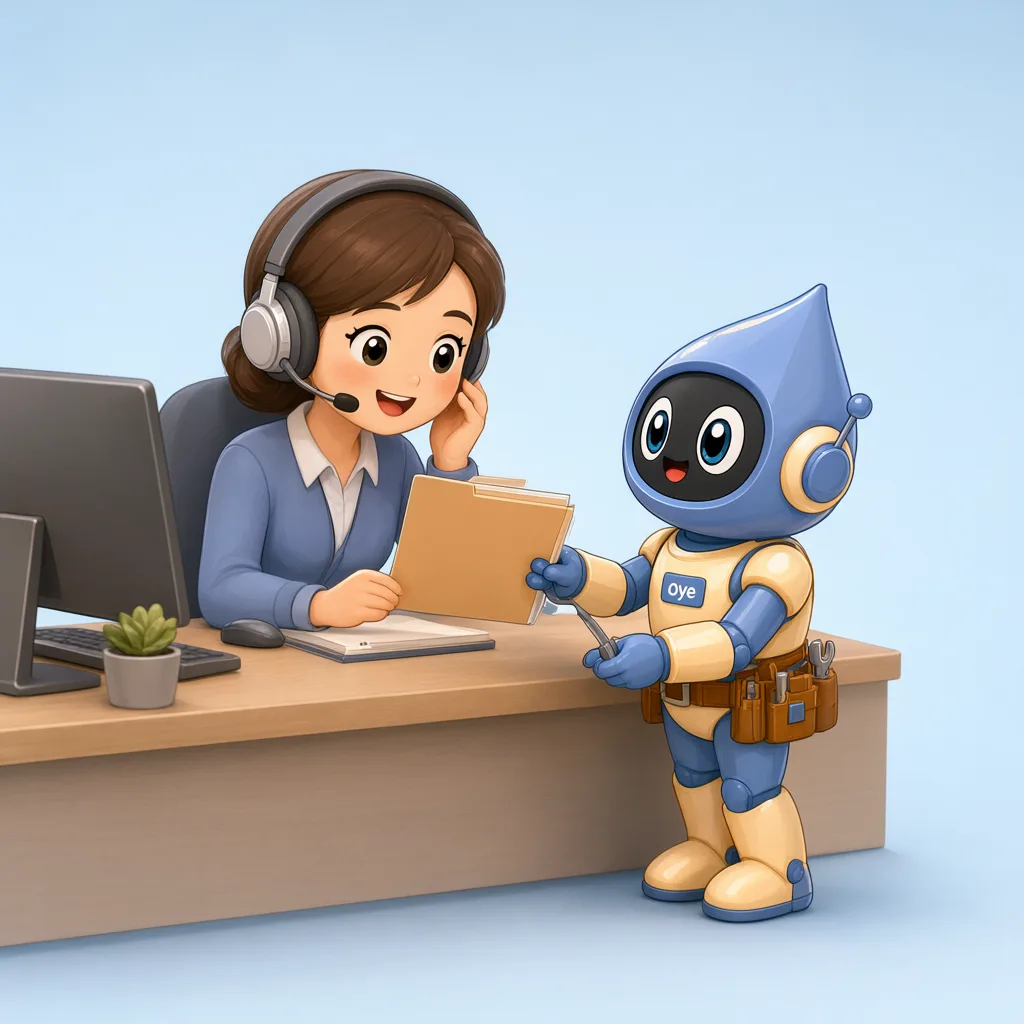
Keep people on the front line
Fully automating customer support is a bet against your own customers. Automate the work around your team instead, and let people do the part customers came for.
You have been in this conversation. Something went wrong with an order, a bill or a booking, and you open the support chat. A cheerful window asks how it can help. You explain. It offers you three help articles, none of which describe your problem. You rephrase. It offers the same three articles. You type "agent". Then "human". Then "REPRESENTATIVE", in capitals, the way people shout at a phone tree.
Nobody has ever left that conversation thinking better of the company.
It is one of the things I believe most firmly about this work: fully automating customer support, or any role where your company meets its customers, is a bad idea. The better bet is to keep people in those seats and automate the work around them, so the time they spend with customers is better than it was before.
The full-automation bet, and how it went
The pitch for replacing support teams is simple arithmetic. A conversation with a person costs a few dollars; one with a model costs cents. Multiply by a year of tickets and the slide writes itself.
Some well-known companies took that bet in public. In February 2024, Klarna announced that its AI assistant was doing the work of 700 customer service agents. In May 2025, its CEO told Bloomberg the company was hiring people for support again: the automated service was cheaper, but lower in quality, and customers should know that "there will always be a human if you want". His conclusion was that investing in the quality of human support "is the way of the future" for them.
In August 2025, Commonwealth Bank of Australia reversed its decision to cut 45 customer service roles that a new voice bot was meant to replace. The bank said its assessment "did not adequately consider all relevant business considerations", called it an error, and apologised to the staff. The union's account was that call volumes had gone up, not down, and team leaders had been pulled onto the phones.
Neither company is foolish, and both had better technology than most. The arithmetic was right. What it counted was wrong.
What customers actually want
The numbers on cost are easy to find. The numbers on what customers think are less often quoted. In a Gartner survey of 5,728 customers, 64% said they would prefer that companies didn't use AI for customer service, and 53% said they would consider switching to a competitor if they found out a company was going to. Their biggest worry was not wrong answers or lost jobs. It was that it would get harder to reach a person.
That matches what you already know from your own life. When something has gone wrong, you don't want a faster answer. You want someone who understands the problem, has the authority to fix it, and cares a little that it happened. A good support person turns a bad day into the reason you stay. Customers remember the person who sorted it out, and they tell other people about them.
There is a second loss that never shows up in the cost model. The support desk is where a company hears the truth about itself: the stale pricing page, the confusing step in onboarding, the feature everyone keeps asking for. I wrote about what it takes to get that signal to the people who can act on it. Replace the people on the front line with a system that deflects tickets, and you don't just lose warmth. You lose your best source of information about your own product.
Automate the work around the conversation
None of this means support should stay as manual as it is. Look at what a support person actually spends a day on, and most of it isn't talking to customers. It is the work around the conversation:
- Before: finding the customer's account, their last orders, their previous tickets, the right policy, scattered across four tools and a shared drive.
- During: looking up the answer, checking what they're allowed to offer, copying details from one system into another.
- After: writing up the case, tagging it, filing the follow-up, updating the CRM, telling the product team about the bug.
That is the work an automated workflow should take. When the conversation starts, the case is already assembled on one screen: who the customer is, what happened, what was tried last time. While the person listens, the workflow drafts a reply and finds the relevant policy, for them to use, change or ignore. When the call ends, the summary is written, the follow-up is filed and the bug report is on the right team's board, for the person to check and send.
What stays with people is everything the customer came for: listening, judgement, the exception to the rule, the apology that sounds like it was meant, the decision to make it right. The person is still the one the customer talks to. They just walk into every conversation prepared, and walk out of it without forty minutes of paperwork.
A rule of thumb I use to draw the line: if a customer would be annoyed to learn a machine did it, a person should do it. If they'd be annoyed to learn a person spent twenty minutes on it, automate it.
Measure the right thing
The full-automation bet usually comes with a metric that rewards it: tickets deflected, conversations handled without a person, cost per contact. Each of those can go up while customers get quietly angrier.
If you automate around your team instead, measure what the customer feels:
- Time to a good answer, not time to the first reply.
- Whether the problem stayed solved, or the customer had to come back.
- How much of your team's day is spent with customers, as opposed to on the tools around them.
- Whether customers stay.
Done well, the same team handles more conversations, each one better, and the people doing the work have the part of the job they were good at left, rather than the part that wore them down.
Why I build it this way
The workflows I build for small companies follow this belief. A person stays in the loop wherever a customer is on the other end, every hand-off and escalation is designed rather than left to chance, and every action the workflow takes is logged, so the team can see what it did and why. Where the conversations carry sensitive data, the models can run on hardware the company controls, so what customers tell you stays with you.
If your support team is buried in the work around the conversation, I would like to hear what that work looks like. Book a 20-minute call and we'll find the part worth automating, and keep the part your customers came for.
Putting agents into your business?
We help enterprise teams move from agent demos to production. Free assessment call, no commitment.
Book an Assessment